

August 8, 2026 – With the rapid iteration of 5G communication, intelligent aerospace, automotive radar and high-precision industrial equipment, the electronic manufacturing industry has raised stricter standards for signal transmission efficiency, structural stability and environmental adaptability of circuit boards. The newly launched High Frequency Rigid-Flex PCB has stood out in the high-end circuit board market by virtue of its unique composite structure and excellent high-frequency signal processing capability. As a mainstream Rigid-Flex Circuit Board integrating rigid and flexible substrate advantages, this High-Quality Rigid-Flex PCB solves the signal loss and structural limitation problems of traditional PCBs, while the customizable design ofCustom Rigid-Flex PCB further meets the personalized demands of high-end equipment manufacturers, becoming an indispensable core component in high-frequency electronic systems.
Different from ordinary rigid PCBs and flexible PCBs with single performance, the Rigid-Flex PCB adopts a composite stacking structure of rigid dielectric substrate and high-toughness flexible material. The rigid area provides stable support for component welding and circuit fixation, while the flexible area supports multi-angle bending, folding and assembly, perfectly adapting to the integrated design of complex and miniaturized electronic equipment. Especially optimized for high-frequency working scenarios, this High Frequency Rigid-Flex PCB effectively reduces high-frequency signal attenuation, dielectric loss and electromagnetic interference during high-speed transmission, maintaining stable and accurate signal output even under ultra-high frequency operating conditions. It makes up for the fatal defects of traditional circuit boards, such as serious signal distortion and low transmission efficiency in high-frequency environments.
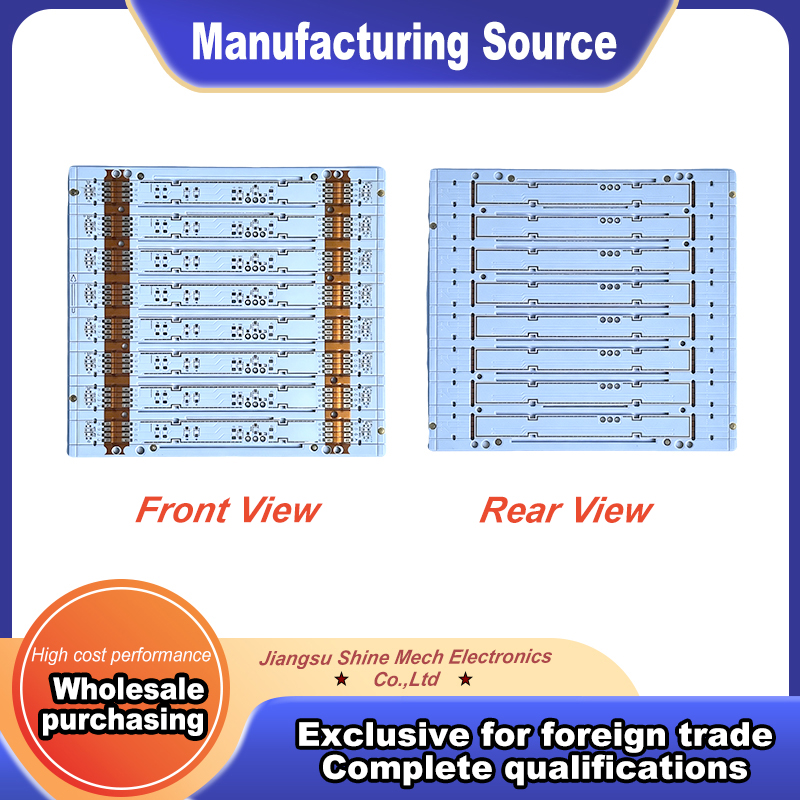
In terms of product performance comparison, High-Quality Rigid-Flex PCB has comprehensive and obvious advantages over ordinary rigid-flex circuit boards and traditional single-structure PCBs. Firstly, in high-frequency performance, ordinary rigid-flex boards mostly use common dielectric materials, which are prone to large signal loss and poor anti-interference ability when working above 1GHz. In contrast, the high-frequency model adopts low-dielectric constant and low-loss special materials, which can stably support high-frequency signal transmission above 10GHz, with a signal loss rate reduced by more than 30% compared with ordinary products. Secondly, in structural adaptability, traditional rigid PCBs cannot be bent and have limited assembly space, while pure flexible PCBs have insufficient bearing capacity for precision components. The optimized Rigid-Flex Circuit Board combines the advantages of both, with strong structural stability and flexible assembly performance.
Thirdly, in durability and environmental resistance, ordinary rigid-flex products are prone to circuit cracking and layer separation after long-term bending and high-frequency operation. The High-Quality Rigid-Flex PCB undergoes high-precision lamination and high-temperature curing technology, with strong bonding force between layers, excellent bending fatigue resistance and thermal stability, and can adapt to harsh working environments such as high temperature, high humidity and strong electromagnetic interference. In addition, the Custom Rigid-Flex PCB service breaks the limitations of standardized products. Manufacturers can customize the number of layers, board thickness, bending range and impedance parameters according to customers’ equipment specifications, realizing one-stop matching for personalized and differentiated product needs, which is not available in ordinary standardized circuit boards.
Aiming at the market procurement demand for High Frequency Rigid-Flex PCB, industry procurement experts have released professional procurement guidelines to help manufacturing enterprises select cost-effective and high-reliability products correctly. First of all, select products according to application scenarios. For ordinary low-frequency consumer electronic products, standardized ordinary Rigid-Flex PCB can meet the demand and control procurement costs. For high-frequency fields such as 5G communication equipment, radar detection, aerospace precision instruments and high-speed industrial control equipment, enterprises must prioritize high-frequency specialized models to avoid equipment performance degradation caused by insufficient signal transmission performance.
Secondly, focus on product quality and certification. When purchasing High-Quality Rigid-Flex PCB, enterprises need to verify the product’s high-frequency test reports, dielectric loss parameters and industrial certification qualifications, and check the consistency of lamination process and circuit precision, so as to eliminate unqualified products with unstable performance. Thirdly, make full use of Custom Rigid-Flex PCB customization services. For equipment with special structural sizes and high-frequency impedance requirements, customized design can effectively improve equipment assembly accuracy and operating stability, and reduce later maintenance costs.
Fourthly, balance performance and cost. Avoid blindly pursuing high configuration for low-end scenarios, and do not cut corners on material and process for high-frequency precision equipment, so as to ensure the long-term stable operation of electronic systems. As high-speed and high-frequency electronic equipment becomes the mainstream of the industry, the market demand for high-performance Rigid-Flex Circuit Board will continue to rise. With its professional high-frequency performance, composite structural advantages and flexible customization capabilities, the High Frequency Rigid-Flex PCB will continue to lead the upgrading of the rigid-flex PCB industry and provide solid technical support for the development of high-end electronic manufacturing.